Want your product to take over a city? do it with mixed reality

Cities are saturated with advertising. Billboards, screens, posters, and digital displays compete constantly for attention, yet most of them fade into the background. People are used to these formats, which leads to ad fatigue.
Mixed Reality (MR) breaks this pattern by turning the city itself into the narrative. Instead of placing products inside predefined ad spaces, MR allows brands to stage extraordinary moments inside real urban environments—then release those moments as cinematic social media content.
In this context, Mixed Reality is not an experience the audience activates. It is a visual production technique. The final output appears as a realistic video where digital objects blend seamlessly into real city locations, designed to stop the scroll, spark curiosity, and invite sharing on platforms like Instagram and TikTok.
Mixed reality turns cities into brand experiences
In social media campaigns, Mixed Reality refers to spatially accurate digital content embedded into real-world locations during production. The audience consumes the result as a finished visual story, not as an interactive experience.
Unlike basic CGI, MR content follows the logic of the physical environment. Scale, perspective, lighting, and depth are treated as constraints, not effects. Digital objects appear to occupy the same space as streets, buildings, and landmarks.
This allows brands to place giant products between buildings, suspend vehicles in the air, or reshape familiar cityscapes while maintaining visual credibility. Even when the scenario is impossible, it feels believable because the city’s spatial rules remain intact.
The city stops being a backdrop and becomes part of the brand experience.
From static ads to street level interaction
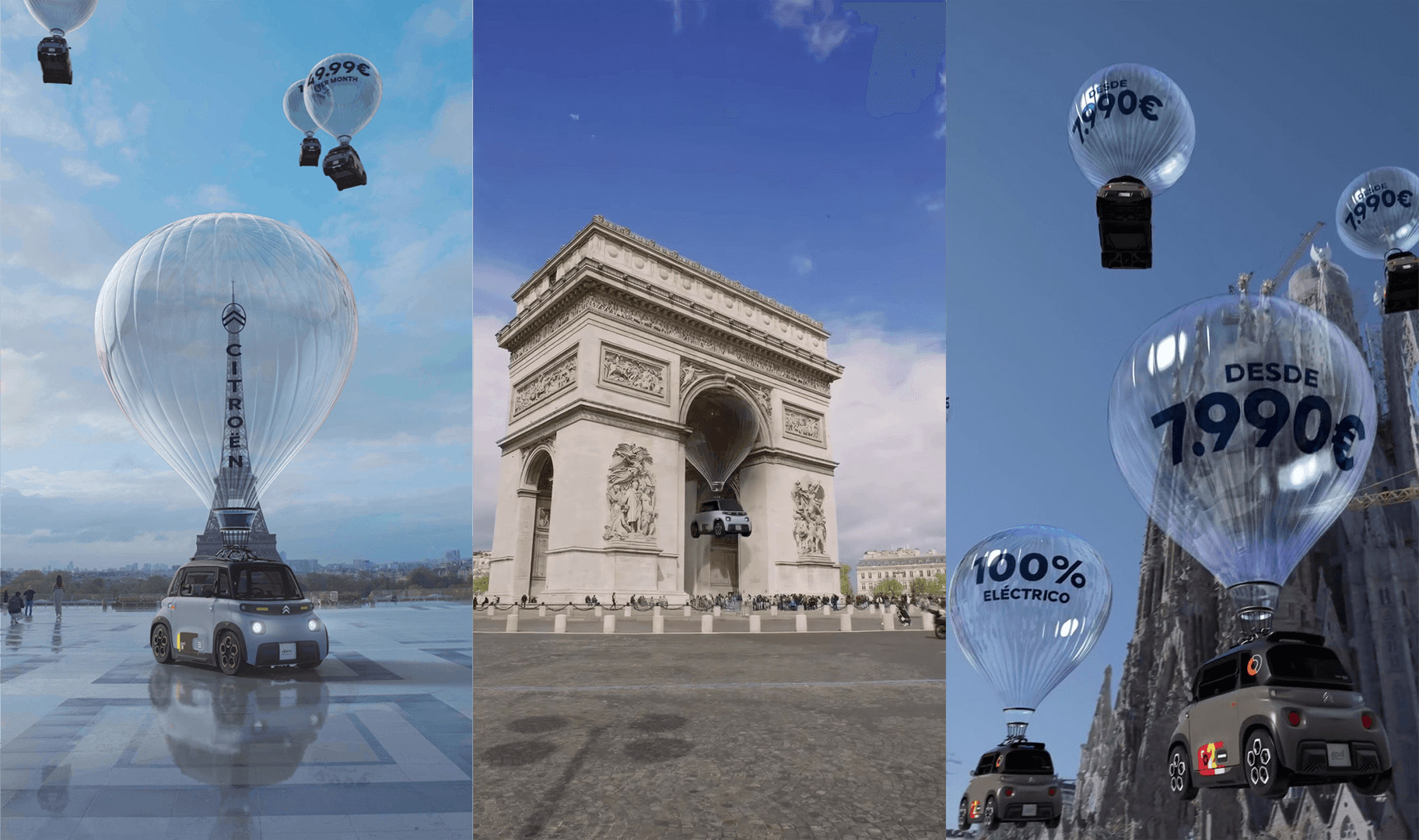
Traditional outdoor ads are passive and easily ignored. Mixed Reality replaces static placement with street-level cinematic moments designed for social viewing.
Instead of delivering a message, MR stages a scene. The product exists inside the city and is framed as part of everyday urban life—just altered in an unexpected way.
Effective Mixed Reality social content typically includes:
Spatial grounding
Digital objects align naturally with streets, buildings, and landmarks, reinforcing realism.Perspective-led storytelling
Movement and framing guide how the viewer discovers scale, detail, and context.Environmental behavior
Objects respond visually to gravity, distance, and surrounding structures, making them feel physically plausible.Time-based progression
Scenes evolve over time, creating a sense of unfolding rather than a single static reveal.Audience immersion through viewpoint
The viewer experiences the moment as if witnessing something real happening in the city.
This approach transforms advertising into a visual event rather than a message.
Giant products work when they make sense
Scale alone does not create impact. A giant object placed randomly in a city may attract brief attention, but without context it quickly becomes visual noise.
The strongest Mixed Reality campaigns use scale as a narrative device. A giant product works when it reflects the brand’s role in daily life or its cultural relevance. Mobility brands naturally belong on streets and landmarks. Lifestyle brands feel more credible in social, commercial, or leisure-oriented areas.
From a production perspective, meaningful scale depends on precision. When digital objects align with architectural lines, street layouts, and human proportions, the moment feels intentional rather than gimmicky.
In Mixed Reality, scale should communicate meaning—not just spectacle.
Mixed reality as experiential branding
Brands use Mixed Reality as experiential branding because it allows people to feel a product’s presence rather than simply understand its features.
Even as a non-interactive format, MR delivers experience through visual realism, narrative context, and emotional resonance. The city provides familiarity, while the digital layer introduces surprise.
These experiences can take many forms: cinematic product reveals, symbolic digital structures, or city-scale visual metaphors. Because they are tied to recognizable locations, they feel specific and memorable rather than generic.
This sense of place turns social content into a branded moment—something that feels discovered, not advertised.
Why mixed reality performs well on social media
Mixed Reality content performs strongly on social platforms because it disrupts visual expectations.
The scenes look real at first glance, then reveal something impossible. This contrast creates curiosity and encourages sharing. Viewers repost not because they are prompted to, but because the content feels unusual and culturally relevant.
MR visuals also age well across formats. A single production can generate multiple edits, cuts, and crops, extending reach across feeds, stories, and reels.
Most importantly, Mixed Reality does not resemble traditional advertising. It looks like something extraordinary happening in a real place—which is exactly what performs best in fast-scrolling environments.
Mixed reality is more than a visual trick
At its best, Mixed Reality is not about technology. It is about communication.
MR allows brands to express ambition, scale, and confidence through visual storytelling instead of slogans. When spatial logic, rendering quality, and environmental consistency are handled correctly, the illusion becomes credible.
This is where MR becomes a storytelling medium. Brands communicate meaning through how objects occupy space, how they relate to the city, and how familiar environments are transformed into narrative scenes.
Products no longer appear on screens. They appear inside the world people recognize.
Conclusion
Mixed Reality allows brands to take over cities digitally and distribute those moments as powerful social media content. Giant products, floating visuals, and cinematic street scenes can exist without physical installations while still feeling real and grounded.
When combined with strong storytelling and thoughtful spatial design, Mixed Reality creates attention, emotional engagement, and shareable moments that traditional advertising cannot match.
Ready to imagine your product at city scale?
Visit gnmotion.co and start designing Mixed Reality stories people stop for, watch, and share.
