Guides10 min read
What is a 3D billboard, and how much does one cost?
How anamorphic 3D billboards work: viewing angle, corner screens, file specs, production steps, timeline and cost, and how they differ from FOOH.
A 3D billboard, also called an anamorphic billboard, is a digital screen in a public place that plays a CGI film drawn in forced perspective, so the image seems to leave the screen when seen from one viewing spot. It usually wraps a corner or curved LED screen, and people see it in the street, not only online.
GN Motion makes the CGI films that play on these screens, and the social cuts that carry them further. This guide covers how the illusion works, which screens suit it, what the media owner will ask for, how a film is made, and what it takes in time and budget.
What is the difference between a 3D billboard and FOOH?
A 3D billboard is a real screen that people see in the street. A FOOH, short for fake out of home, has no screen at all: it is a CGI product composited into footage of a real place, made only for social media.
The two are often confused because both play with scale and both end up as videos on Instagram and TikTok. The difference matters when you plan the campaign:
- Where it lives. A 3D billboard lives on one screen, in one city, for the length of the booking. A FOOH lives in the feed, anywhere in the world.
- What it costs. A 3D billboard needs the film and the screen time. A FOOH needs the film and, sometimes, a location shoot. There is no media booking.
- What it can show. A 3D billboard is limited to what fits inside the screen and reads from its viewing point. A FOOH can put a product over a cathedral or a mountain range.
- What it proves. A 3D billboard happened: passers-by saw it, and their phone videos are real. A FOOH is a well-made illusion, best presented openly as CGI.
What FOOH is and how it is made covers the social format in detail. The rest of this page is about the physical screen.
How does the anamorphic illusion work?
The film is drawn for one point of view. From there, the eye reads the flat screen as a window or a box with depth, and anything that crosses its painted edge seems to come out of it.
Anamorphosis is an old painting technique: an image distorted on purpose so that it only looks right from one place. On a 3D billboard, the studio builds the screen and the street in 3D, puts a virtual camera where the audience will stand, and renders the film through that camera. Seen from the side, the image looks stretched. Seen from the sweet spot, it looks solid.
Three things make it convincing:
- A viewing point. The illusion is strongest from one area, usually the busiest place to stand: the crossing in front of the screen, a station exit, the far side of a square. The further a viewer stands from it, the flatter the image looks.
- A fake frame. The film draws its own edges: a box, a frame, a room or a window. That frame gives the brain a surface to compare against, so when the product breaks through it, the eye reads depth.
- Shadows and light. Objects cast shadows onto the painted inside of the box, and the light inside it matches the scene. Without these, a 3D object looks pasted on.
Which screens work best for a 3D billboard?
Corner and curved screens work best, because their two visible faces give the illusion real geometry to work with. A flat screen can carry the effect, but more softly.
- Corner (L-shaped) screens. Two faces meet at a building's corner. Seen from the diagonal, the fold disappears and the screen reads as one box. This is the classic format of the best-known 3D billboards.
- Curved screens. The curve plays the same role as a corner, with a softer fold. The giant 3D cat on the Cross Shinjuku Vision screen in Tokyo, in 2021, was made for a curved screen above Shinjuku Station's east exit.
- Flat screens. The depth comes only from what is drawn inside the film: a frame, a recess, a shadow. It works best from a fixed, frontal viewing point, such as a screen at the end of a street or inside a mall atrium.
- Indoor screens. Lobbies, malls, airports and flagship stores also have LED walls. People stand closer and stay longer, so the viewing point is easier to control.
Before any concept, ask the media owner where people stand, from how far they see the screen and for how long. A screen seen from a moving car needs a simpler, slower idea than one seen from a café terrace.
What specs does a 3D billboard file need?
Every screen has its own spec sheet, and the media owner's sheet always wins. It sets the pixel size, frame rate, codec, file format, length and loop rules, and sometimes a brightness or content limit.
What to expect from a typical spec sheet:
- Resolution. The screen's exact pixel map, which is rarely a standard video size: corner and curved screens are often very wide or split into two faces. The film is rendered at that native size, pixel for pixel, never scaled.
- Frame rate. Set by the screen's player, commonly 25, 30 or 60 frames per second. Fast motion looks smoother at a higher frame rate, which also lengthens render time.
- File format. Usually an MP4 or MOV file in a codec the player accepts, such as H.264 or ProRes, and sometimes a still-image sequence. The media owner says which.
- Length. Cut to the slot, often 10, 15 or 30 seconds, and built to loop cleanly if the screen plays it on repeat.
- Sound. Most outdoor screens play without sound, so the idea has to read with the sound off.
- Safe areas. Parts of a screen can be hidden by a building edge, a sign or a tree from the viewing point. The layout keeps the key moment and the logo out of them.
Ask for the spec sheet, a photo or video taken from the viewing point and the screen's exact dimensions before the storyboard. They change the concept, not only the delivery.
How is a 3D billboard made?
In six steps, from the screen's spec sheet to a film running in the street.
- Brief and screen survey. You send the product, the goal, the launch date and the screen. The studio gathers the spec sheet, the dimensions and reference photos from where people stand.
- Concept. One clear idea that reads in a few seconds without sound: the product rising out of the box, breaking the frame, or filling the building. The concept is drawn from the viewing point, not from the front.
- 3D layout. The screen, the building and the street are rebuilt in 3D, with a virtual camera at the sweet spot. Rough blocks test where the product sits, how big it looks and where it breaks the frame.
- Animatic. A rough animated version, rendered through the viewing-point camera and laid onto a photo of the real screen, to check timing and the illusion before full production.
- CGI production. Modelling, materials, animation, simulation and lighting, as in any CGI product film. The product is built once, at full detail, so it holds up on a screen several floors tall.
- Delivery and test. The film is rendered at the screen's native size, checked on a virtual copy of the screen, then delivered to the media owner for their test before it goes live. Social cuts are rendered from the same scene.
The production steps are the same as for our CGI product films; what changes is the camera, which is fixed at the viewer's eye, and the file, which is cut to one screen.
How long does a 3D billboard take to make?
At GN Motion, an anamorphic film follows the CGI timeline: 1–3 weeks for a standard film and 2–5 weeks for a premium one. Add the media owner's approval and on-screen test, and book the screen early: popular screens sell out around big launches and holidays.
What moves a film within that range:
- The product model. A clean CAD or 3D file saves time; building the product from photos takes longer.
- The simulation. Liquids, smoke, cloth or particles add render and review time.
- The number of screens. Each screen has its own pixel map and viewing point, so each one is its own render, even with the same idea.
- Feedback speed. A day of waiting on a review is a day added to the schedule.
How long a CGI product film takes goes through each stage in more detail.
How much does a 3D billboard cost?
A 3D billboard has two budgets: the film, made by a studio, and the screen time, sold by the media owner. They are separate, and both depend on scope.
The film's price follows the length, the number of screens, the complexity of the product and its simulation, and the social cuts you need. At GN Motion, a 3D billboard is a custom project: send a brief and you get a tailored budget within 24 hours. For reference, our Hero Film, a premium CGI film with its cutdowns, starts at $20,000. The pricing page lists what each plan includes and how custom projects are scoped.
The screen time is priced by the media owner, by slot, day or week, and depends on the city, the screen and the season. Ask them early: the booking often decides the launch date, not the other way round.
Do 3D billboards work?
They work when the idea is simple and the screen sits where people stop and look. The best-known examples became news because passers-by filmed them and shared the videos.
- Wave, COEX K-Pop Square, Seoul (2020). A public media art piece by d'strict: crashing water that seems held inside a glass tank on a vast curved screen. It showed how far a curved LED wall can carry depth.
- The Shinjuku 3D cat, Tokyo (2021). A giant calico cat leaning out of the curved Cross Shinjuku Vision screen, made for the building's owner. Its videos travelled worldwide.
- Louis Vuitton x Yayoi Kusama (2022). For the collaboration's launch, an anamorphic film on the same Shinjuku screen showed a Damier trunk opening and Kusama's pumpkins rising out of it, part of a wider takeover of Tokyo.
What they share: one idea, readable without sound, a frame that the subject breaks, and a viewing point full of people with phones. The screen reaches the people who pass it; the videos of the screen reach far more.
What does GN Motion deliver for a 3D billboard?
The anamorphic film at the screen's spec, the social cuts rendered from the same scene, and the product film for your website, all from one CGI build.
- The screen film, rendered from the viewing point at the screen's native size, frame rate and format, and checked on a virtual copy of the screen.
- Social cuts: 9:16 and 4:5 versions framed from the street's point of view, so the illusion still reads on a phone.
- A clean product film in 16:9, and stills, for the website and the launch.
- Previews at each stage: the 3D layout, the animatic on a photo of the screen, then the final render.
The craft comes from our CGI product work. For L'Oréal's AirLight Pro, we made a full CGI film that was displayed across France, from pop-up stores to innovation events. For Samsung's Galaxy S25 Edge, giant beams of light sculpt the phone in a dark space, the kind of high-contrast lighting that reads on an LED screen from far away.
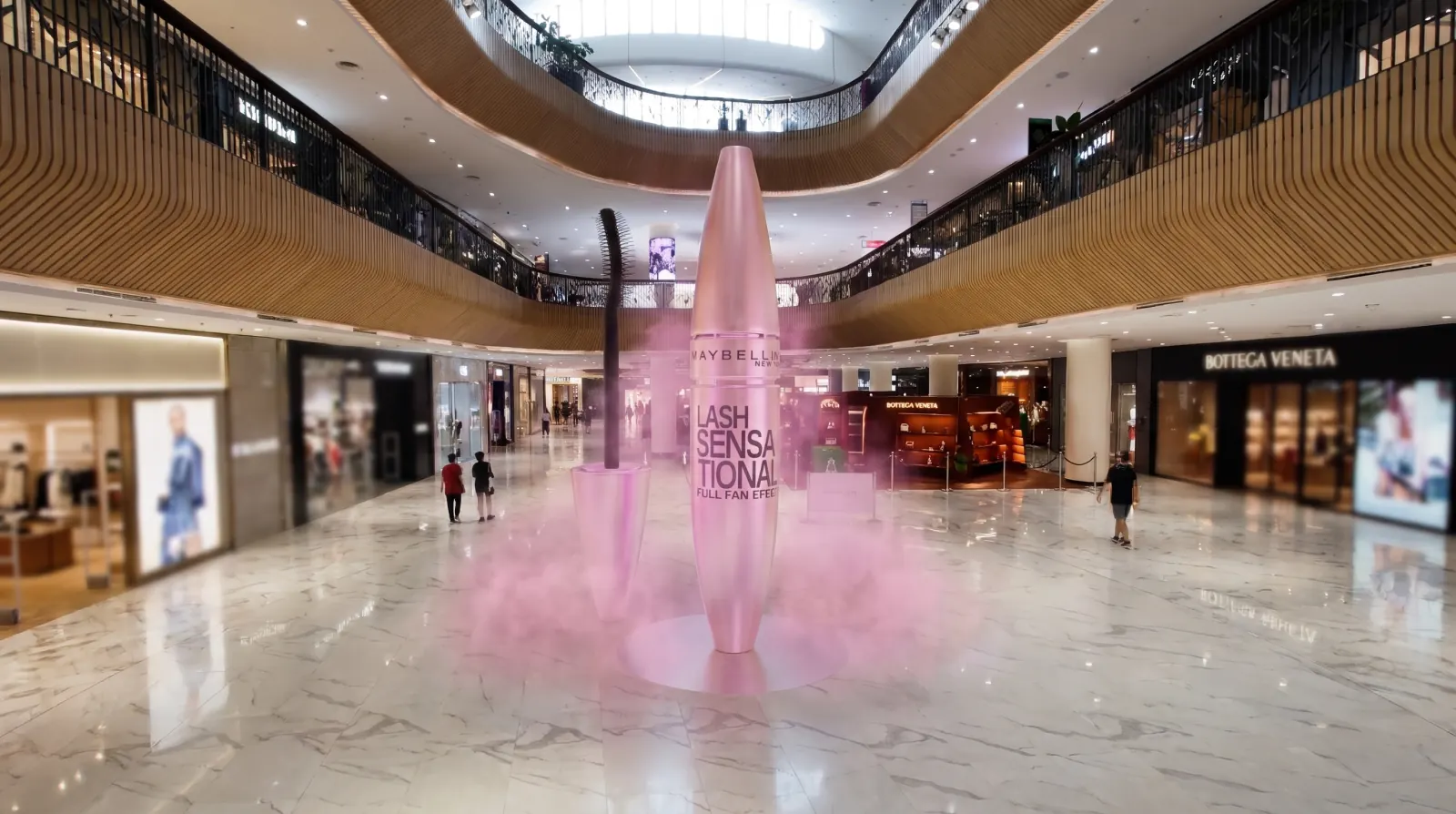
Placing a giant product in a real space is the core of our mixed reality work. In a self-initiated concept, made on our own initiative and not commissioned by the brand, a giant Maybelline Lash Sensational mascara rises in a mall atrium in a pink cloud, its scale locked against the real space. For Citroën, we dropped the no-permit Ami by balloon over Paris, Rome, the Sagrada Família and the Greek coast in three social films.
We work with brands in Europe, Singapore and across Asia, Dubai and the Middle East, and worldwide. Wherever the screen is, the film is built to its media owner's sheet.
When is a 3D billboard not the right choice?
When the screen is seen from too many angles, from a moving car at speed, or for a second at most, the illusion has no time to land. A flat 2D film, or a FOOH made for social media, can do more for the same budget.
It is also the wrong tool when the goal is reach alone. A FOOH can be posted in every market at once; a 3D billboard reaches one place, and its life online depends on people filming it. Many brands do both from one idea: a real screen in one city, and a FOOH or social cut for everywhere else.
See how we make mixed reality and FOOH campaigns, read what CGI advertising is, or send us your screen and brief.